The Architecture of Restraint
Defining the New Pakistani Silhouette
A critique of superficial ornamentation and the case for negative space in contemporary subcontinent tailoring.

Why true luxury lies in negative space, unconstructed shoulders, and letting the raw fiber speak louder than ornamentation.
“We stripped away the decorative distraction until only the structural spine and the breath of the silk remained.”
NAVA Manifesto on Form, 2026
I. The Weight of Excess
For decades, the standard vocabulary of South Asian luxury has been calibrated to density: how densely an organza can be frosted in metallic wire, how heavily an ensemble can drag against the body, how loudly a surface can declare its monetary expense.
Yet when one studies the historical drapery of the Indus Basin—the unstitched lengths of hand-spun cotton that responded to the dry desert winds of Sindh and the monastic purity of Gandharan folds—one discovers an entirely different lineage: one founded on balance, kinetic grace, and structural repose.
II. Unconstructed Geometry & Suited Restraint
At NAVA, our exploration of the contemporary silhouette begins with subtraction. Rather than layering padding and horsehair canvas to forge an artificial posture, we engineer garments that fall from the natural clavicle line with architectural precision.
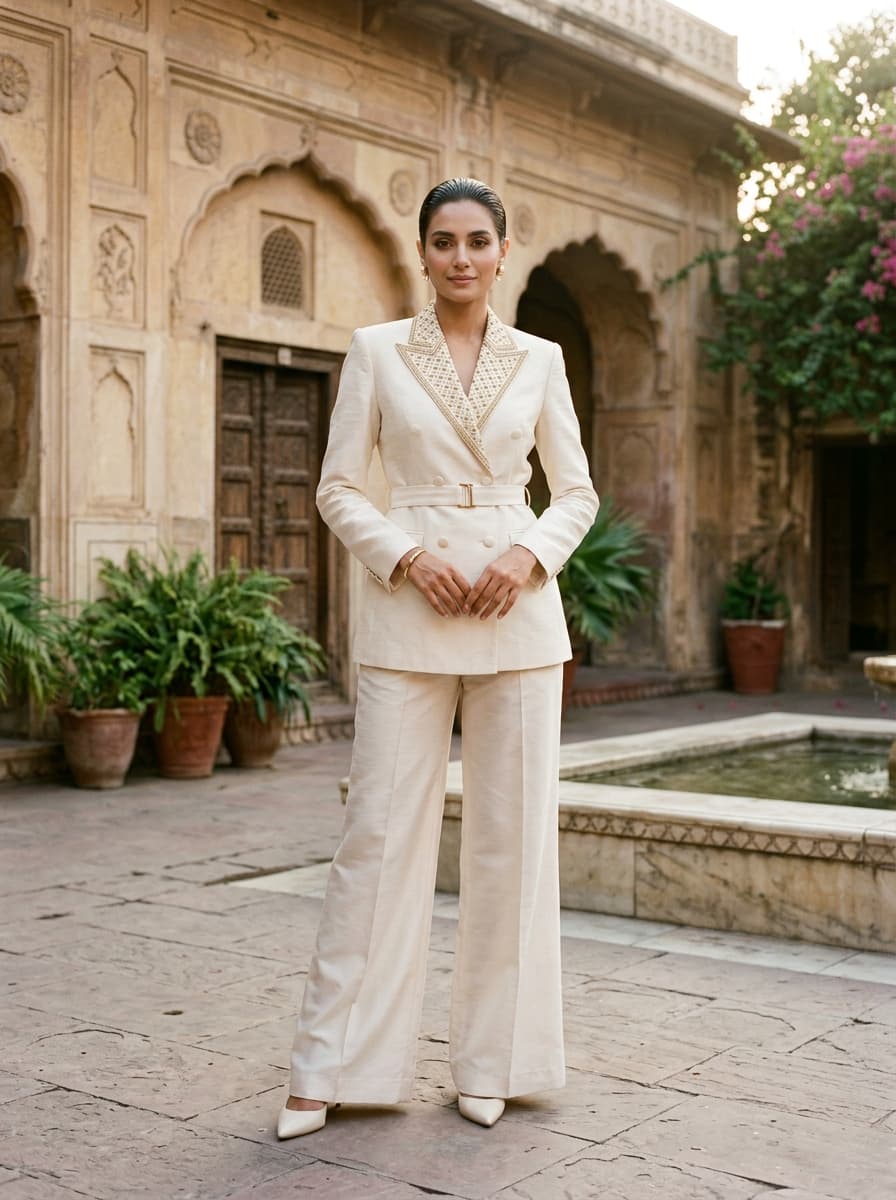
Our new bespoke Ivory Raw Silk Pant Suit and Obsidian Bandgala embody this exact dialogue. Spun from indigenous handloom tussar silk in South Punjab, the peaked lapels carry delicate geometric gold zardozi, relying strictly on the natural tensile weight of the woven yarn without synthetic backing.
III. The Luxury of Negative Space
Negative space is not empty; it is the chamber through which the garment breathes. By deliberately leaving panels unembellished, we allow the viewer's eye to perceive the micro-variations of raw slub, the deep absorption of light, and the clean edge of a hand-rolled hem.
This is not minimalism in the Western corporate sense. It is an intentional austerity that honors the dignity of the artisan's foundational weave before any decorative intervention occurs.